Download the
Paisabazaar app Today!
Paisabazaar app Today!
Get instant access to loans, credit cards, and financial tools — all in one place

Win Assured Cashback

Our Advisors are available 7 days a week, 9:30 am - 6:30 pm to assist you with the best offers or help resolve any queries.


Get instant access to loans, credit cards, and financial tools — all in one place

Scan to download on



 Personal Loan
 Business Loan
 Home Loan
 Other Loans


Our Advisors are available 7 days a week, 9:30 am - 6:30 pm to assist you with the best offers or help resolve any queries.

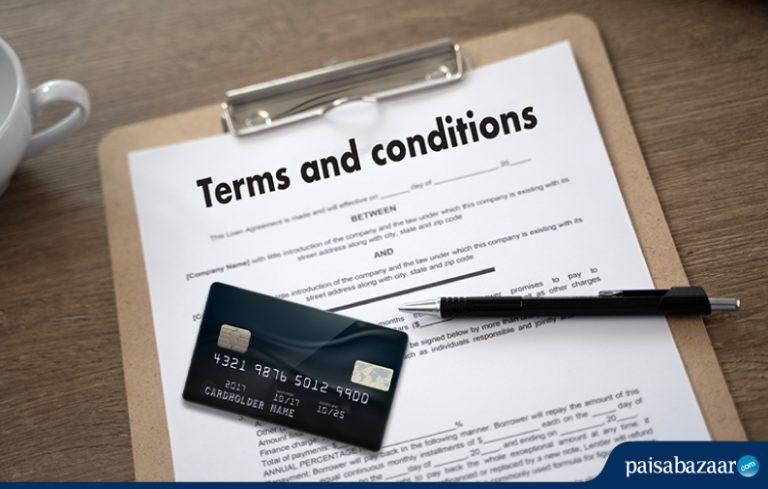
When applying for a credit card what we tend to do is quickly glance at the credit card terms and conditions page and then focus more on the attractive offer page to read about the perks and benefits. It is true to say that all benefits and rewards often come with certain limitations and so is the case with credit cards. If you need to know everything about your credit card including the fees, benefits, restrictions etc, you need to dig deep into the card’s terms and conditions.
Important Credit Card Terms and Conditions
People often ignore the terms and conditions associated with a credit card because first they don’t understand it and second they don’t want to put in the effort to decode a document full of financial jargons. So, here we have explained the 9 significant parts of a credit card MITC (Most Important Terms & Conditions). A credit card MITC could be a 10-page long document but you don’t need to read every page of it. Given below are the terms you surely need to know about:
| Cardholder Agreement | Introductory Offers | Interest Rate |
| Foreign Transaction Fee | Late Fee | Cash Advance |
| Bill Payment T&C | Add-on Card T&C | Rewards |
A cardholder agreement is a legal document that establishes a contract between the cardholder and the issuer and outlines the obligations both have towards each other. The MITC which includes fees and charges related to the card is, in fact, a part of the cardholder agreement.
Your credit card may come with some introductory offers like extra discount with select brands for the first year, no charges on balance transfer for 6 months and the like. These are offered by the card issuers to attract the customers but there are some underlying conditions for those introductory offers which may be related to spending restrictions or offer period. You must read the MITC (Most Important Terms & Conditions) document to know the terms related to the introductory offers.
If you fail to pay the full amount as mentioned in your credit card statement within the monthly deadline you would attract interest or finance charges on the outstanding amount.
For example, if the total amount payable for the month is Rs 20,000 and you choose to pay only Rs 10,000, the balance amount (i.e. Rs.10,000) would attract interest generally ranging from 35-45% per annum. Given below are the finance charges on some popular credit cards:
| Credit Card | Interest Rate (per annum)* |
| HDFC Regalia | 41.88% |
| SBI Card Elite | 40.2% |
| ICICI Rubyx Credit Card | 40.80% |
| Citibank Cashback Card | 37.20% to 42.00% |
Whenever you use your credit card to make payment in a foreign currency, you will be required to pay a foreign exchange mark-up fee.
For example- With your HDFC Regalia Credit Card, you made a payment of $150 and the foreign exchange mark-up fee is 2% and the value of $1 on the day of payment was Rs. 70.
This transaction will cost you-
The foreign exchange mark-up fee on credit cards in India may range from 1.75% to 3.5%. The table below shows foreign currency mark-up charges on some popular credit cards:
| Credit Card | Foreign Exchange Mark-up Fee |
| SBI Card ELITE | 1.99% |
| HSBC Platinum Credit Card | 3.5% |
| Citi PremierMiles Credit Card | 3.5% |
| Axis Bank Vistara Signature Credit Card | 3.5% |
Late payment charges are applicable when you are not able to pay the minimum amount due on or before the due date. Banks usually offer a 3-day grace period after your due date and if you pay within the grace period, the late fee will be reversed.
Credit Card issuers allow you to withdraw cash from ATMs using your credit card. This is known as Cash Advance. Cash limit is only a portion of the total credit limit. There are two important points to note about cash advance:
Here is the cash advance fee charged by some of the leading banks in India:
| Credit Card Providers | Cash Advance (Withdrawal) Fee |
| HDFC Credit Card | 2.5% of the amount withdrawn or Rs. 500 whichever is higher |
| SBI Credit Card | 2.50% of withdrawal or Rs. 300 per transaction, whichever is higher |
| ICICI Credit Card | 2.50% on the advanced amount, subject to a minimum of Rs. 300 |
| Axis Bank Credit Card | 2.5% of the amount, subject to a minimum of Rs. 250 |
Though it is not recommended to withdraw cash from your credit card, you must know the charges associated with it in case you have to withdraw.
Suggested Read: Reasons why you should avoid credit card cash advance
It is extremely important to pay your credit card bills on time and in full. And to do that, you must be well-acquainted with a few terms that you can also find on the credit card MITC document.
| Bill Payment Terms and Conditions |
| ● Billing Cycle: It is the 30-day period for which you will be billed every month
● Statement Date: Also known as the billing date, this is the date on which your statement will be generated for the billing period ● Due Date: This is the date on or before which you are required to pay your credit card bill for the last billing cycle ● Grace Period: Banks usually offer a grace period of 3 days; making the payment within the grace period will not attract any late fee ● Total Amount Due: This is the total bill amount that you are required to pay on or before the due date ● Minimum Amount Due: This is the minimum amount you need to pay in order to keep your card active and not incur any late fee (a small portion of the total amount due) |
Almost all credit cards in India offer the facility of getting add-on cards (supplementary cards) on the primary credit card. Even if you do not plan on getting one now, you might need it later and hence it is a good idea to check the terms and conditions beforehand. You would want to know the fees and charges along with a basic understanding of how add-on cards work. Read the credit card MITC to find out-
On the front, credit card companies will only show the reward points that you will earn with each transaction but there are certain limitation on earning as well as redemption of the rewards. Look for the answers to the following questions:
Some card issuers do not offer rewards on certain expenditure. For example, most of the Amex credit cards do not earn rewards on utility bill payments, fuel transactions and payment of insurance premium.
Banks usually charge a fixed amount for reward redemption say Rs. 100. In case you are redeeming rewards worth Rs. 5,000, a minimal fee would be fine. However, if the value of your rewards is only getting you a voucher worth Rs. 500, you should know that the actual value you are getting from this transaction is only Rs. 400. It is a good idea to accumulate a good amount of rewards and then redeem for something big.
A lot of credit cards offer bonus reward points as welcome or milestone benefit. In both cases, you will be required to spend a certain amount within a given time period to earn those rewards.

 Limited Time Offer


 with Every Card
Choose a Card Matching Your Lifestyle
Please enter a valid full name
 +91
+91
The entered number doesn't seem to be correct
